The Two-Inch Rule: Why Your Trousers and Boots Need to Talk
There is a moment, usually around the third week of November, when a perfectly nice outfit collapses at ankle level. The coat is right, the knit is right, the bag has behaved itself — and then the trouser hem sits just high enough to expose a sliver of sock, or just low enough to pool unattractively over a boot. Nothing is technically wrong. It simply looks a bit… dampened. The two inches between hem and boot shaft are the least-discussed proportion in winter dressing, and arguably the most useful.
Why the hem-and-boot gap matters more than you think
A winter outfit is read from the ground up more than we care to admit. Shoes and boots anchor the silhouette, and the hemline above them decides whether the whole thing looks intentional or merely assembled in a rush. A cropped trouser with an ankle boot can look sharp and modern — or like you’ve grown out of last season’s length. A wide-leg trouser over a knee-high boot can look expensive and easy — or bulky and uncertain. The difference is rarely the garment itself. It’s the overlap, or lack of it.
This is not a shopping problem. It’s a measuring problem, and a small one. Most of us already own the pieces; we just haven’t asked them to negotiate.
The ankle boot is where outfits lose their nerve
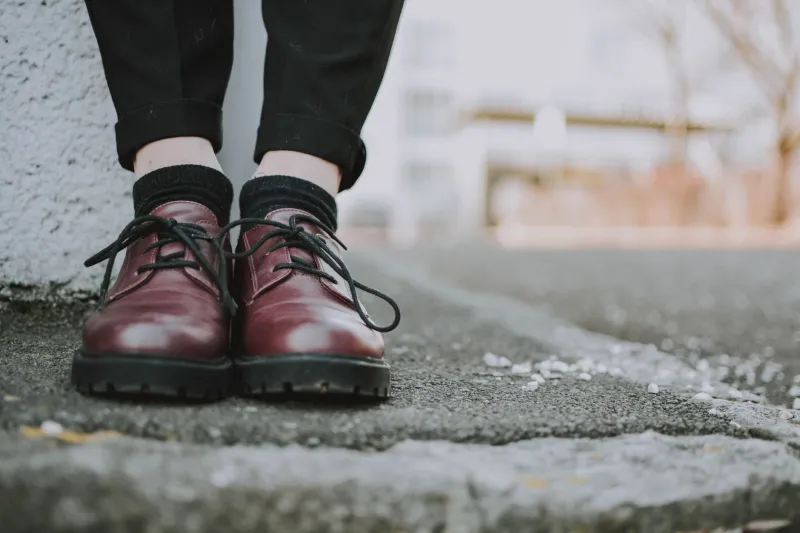
Ankle boots are the workhorse of a British winter, which is precisely why the hem above them deserves a second look. The safest rule is simple: if the boot shaft ends at the ankle, the trouser hem should either clear it entirely or cover it entirely. The awkward middle ground — a hem that grazes the top of the boot, revealing a random inch of shaft — is what makes outfits look unsettled.
For a clean, cropped look, a straight or slightly tapered trouser that finishes just above the boot’s collar works well. Think of it as a deliberate gap, not an accident. For a longer, softer line, let the trouser fall over the boot with enough width to avoid catching on the shaft. A slight break at the front is fine; a full pool is not.
If you’re wearing a skirt or dress with ankle boots, the same logic applies in reverse. The gap between hem and boot should look chosen. Tights help here — they create a continuous line rather than a series of stops. A 40-denier opaque tight in a shade close to your boot colour is the quietest way to make a short skirt and ankle boot feel considered rather than chilly.
Knee-highs and the trouser overlap
Knee-high boots are having a steady, unshowy moment, and they are at their best when the trouser above them is kept simple. The classic mistake is a slim trouser tucked in with too much fabric, which creates a bulge at the knee and ruins the line of the boot. If you’re tucking, the trouser should be close-fitting enough to sit flat, or the boot should be wide enough to accommodate the fabric without strain.
The alternative — and often the more flattering one — is to let the trouser fall over the boot. A straight-leg or wide-leg trouser that skims the top of a knee-high boot creates a long, uninterrupted column. The hem should reach the boot’s upper edge, not stop short of it. If it stops short, you get a visible gap of boot shaft that can look unintentional. If it covers too much, you lose the boot entirely. The sweet spot is a gentle overlap of an inch or two.
Skirts with knee-highs are easier: the rule is about the knee, not the ankle. A hem that sits just above or just below the boot’s top edge will always look more resolved than one that cuts across the middle of the shaft.
Tights, socks and the line nobody notices until it’s wrong
Socks are the supporting cast that occasionally steals the scene. With cropped trousers and ankle boots, the sock becomes a visible design decision. A ribbed wool sock in a colour that echoes the trouser or the boot can look deliberate and warm. A random pop of sports sock is a different mood entirely — fine if you mean it, less fine if you don’t.
With tights, the goal is continuity. Black opaque tights with black boots elongate the leg; black tights with a contrasting tan boot create a visible break that can be charming or clunky depending on the rest of the outfit. Neither is wrong, but both should be chosen rather than defaulted to.
In wet weather, the practical answer is often a thin merino sock inside the boot and a trouser hem that doesn’t drag. A hem that touches the ground in November will wick up water and lose its shape by the time you reach the office. An inch of clearance is not just a styling choice; it’s a small act of self-preservation.
Cropped trousers need precision, not bravery
Cropped trousers are the trickiest player in this game because they leave the ankle exposed by design. In summer, that’s breezy. In a British winter, it’s a commitment. The fix is not to abandon them but to give the ankle a purpose: a boot that meets the hem cleanly, or a sock that becomes part of the look.
A cropped wide-leg trouser with a sleek ankle boot is a strong, modern shape, provided the hem is genuinely cropped — mid-calf or just above the ankle — rather than hovering uncertainly. A cropped straight-leg jean works best with a boot that has a defined shaft, so the eye reads a clear line rather than a blur.
If in doubt, take a photo from knee height. The camera is brutally honest about proportion in a way mirrors are not.
The commute test
Before you leave the house, do the stairs test and the puddle test. Stairs reveal whether a hem catches on a boot shaft or drags. Puddles reveal whether your two inches of clearance are actually enough. A useful rule for British weather: if the hem touches the wet pavement when you walk, it’s too long for the boot you’re wearing. If the gap between hem and boot exposes bare skin in a cold snap, it’s too short for the day.
The answer is rarely a new purchase. It’s a tailor’s tweak, a different sock, a tighter tuck, or simply swapping the boot for one with a different shaft height. The two-inch rule is not about rigid measurement; it’s about noticing the join.
A small fix, not a new wardrobe
Winter dressing is full of these quiet negotiations — the coat-off commute, the in-between forecast, the 4pm palette. The hem-and-boot gap is simply the one at ground level, where the weather actually hits. Get it right and the rest of the outfit feels more resolved without anyone knowing why. Get it wrong and even good pieces can look slightly defeated by the drizzle.
So before you add anything to your basket this month, stand in front of the mirror and look at your ankles. The answer is probably already in your wardrobe, waiting for two inches of adjustment.