The Coat-Off Commute: Dressing for a British Winter That Can’t Regulate Its Temperature

There is a particular kind of British winter misery that has nothing to do with snow. It is the coat-on, coat-off commute: a six-degree morning, a bus that arrives with the heating of a sauna, a department store that has decided it is July, and a train carriage where the windows are sealed and the air is thick. You arrive at work carrying your coat, your scarf and a faint sense of defeat.
The answer is not a bigger coat. It is a better system. Dressing for a British November-to-December is less about building armour against the cold and more about managing transitions. The outfit has to work on the pavement, in the shop, at the desk and on the 17:42 home. That means layers that come off gracefully, fabrics that can be folded into a bag without looking like a rumpled tea towel, and a base layer that does more of the work than the coat.
Start with the layer closest to you
Most people spend their money on the coat and ignore the base layer. This is backwards. The coat is the shell; the base layer is the climate control. A fine merino crew neck, a silk-blend camisole under a shirt, or a close-fitting cotton-poplin top will regulate heat far better than a heavy cotton T-shirt, which tends to hold moisture and feel cold the moment you stop moving. You do not need ski thermals for a day of Christmas shopping in Leeds, but you do need a first layer that feels deliberate when the coat comes off.
Look for fine gauge rather than thick. A merino knit that sits close to the body but does not cling will keep you warm on the street and remain comfortable in a overheated shop. A silk vest under a shirt is a quiet trick that adds warmth without adding bulk. The point is not to dress for the Arctic. The point is to dress for the British winter, which is mostly a series of small temperature shocks.
The mid-layer is the outfit
Once you are inside, the coat comes off. So the mid-layer has to be presentable on its own. This is where a lot of winter dressing goes wrong: we buy a beautiful coat and then wear a shapeless jumper underneath it, which means we spend the indoor half of the day looking as if we are midway through a tidy-up.
A fine-gauge knit, a button-through cardigan, a wool-blend blazer or a quilted gilet all work because they look like clothes rather than insulation. A thin knit in navy, oatmeal or deep green is easy to style and easy to fold. A cardigan is especially useful because you can button and unbutton it as the temperature changes. Avoid the chunky cable knit under a padded coat; it creates bulk and traps heat you will regret in the queue at the till.
The mid-layer should also fit under your coat without feeling compressed. If you can feel the seams of your jumper pressing through the coat sleeves, the whole outfit will feel tight by lunchtime.
Buy a coat that can be carried
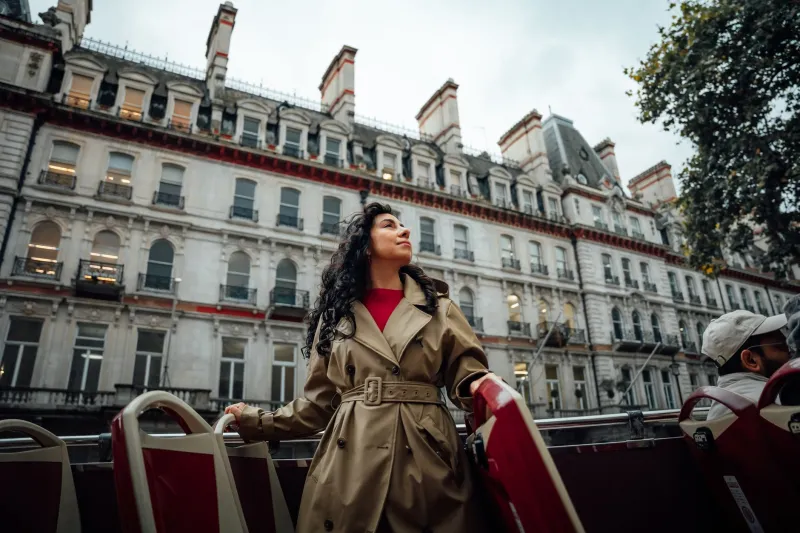
The coat should behave like equipment, not armour. If it is too warm, you will overheat indoors and then freeze when you step back outside because your body has been tricked into thinking it is summer. Look for a shell with room for a mid-layer: an unlined wool trench, a lightly padded jacket, a parka with vents, or a zip-front coat that opens wide when you are on the train. Deep pockets help. A lining that does not stick to a knit helps more.
A coat that only works when it is minus two is wrong for this country. You want something that handles drizzle, wind and a heated bus without turning your day into a physical endurance test. And you want to be able to carry it comfortably over one arm while you pay for a coffee.
Fabrics that survive being stuffed in a bag
This is the unglamorous part of the winter wardrobe, but it matters. Natural fibres with a bit of structure are your friends: merino, fine cotton, silk blends, wool blends. They recover well and do not hold creases like a map of the Northern line. Heavy linen, stiff viscose and bulky cotton are less forgiving when they have been folded into a tote for an hour.
Scarves should be light enough to disappear into a bag. A giant blanket scarf is lovely on a frosty walk and a burden by 11am. Cashmere, cotton-silk or a fine wool wrap will keep you warm without taking over your arm. Fold knits inside out before they go into a bag, and keep one tote with a wide opening and a crossbody strap for days when you know you will be shedding layers.
The practical formula
For a cold street and a hot shop, try a fine merino base, a thin knit or cardigan, wool-blend trousers or dark jeans, an unlined wool coat or zip jacket, leather boots and a small scarf. For the office, keep a pair of shoes under the desk and swap out of boots when you arrive. For a day of shopping, a crossbody bag leaves your hands free for bags, coffee and your coat. For trains, choose a layer with sleeves you can push up without stretching the cuffs.
This is not party-season fantasy dressing. It is the real-world wardrobe that gets you from the doorstep to the office to the pub without looking as if you have been in a fight with the weather.
The mirror test before you leave
Can you take off your coat and still look like you meant it? Does your mid-layer fit under your coat without feeling compressed? Can you carry your coat comfortably over one arm? Can your scarf and gloves fit in your bag? If the answer to all four is yes, you are dressed for the day. If not, edit before you leave.
The most polished person on the train is not the one in the biggest coat. It is the one who looks unbothered. Dress for the transitions, and the British winter becomes a detail rather than a drama.